
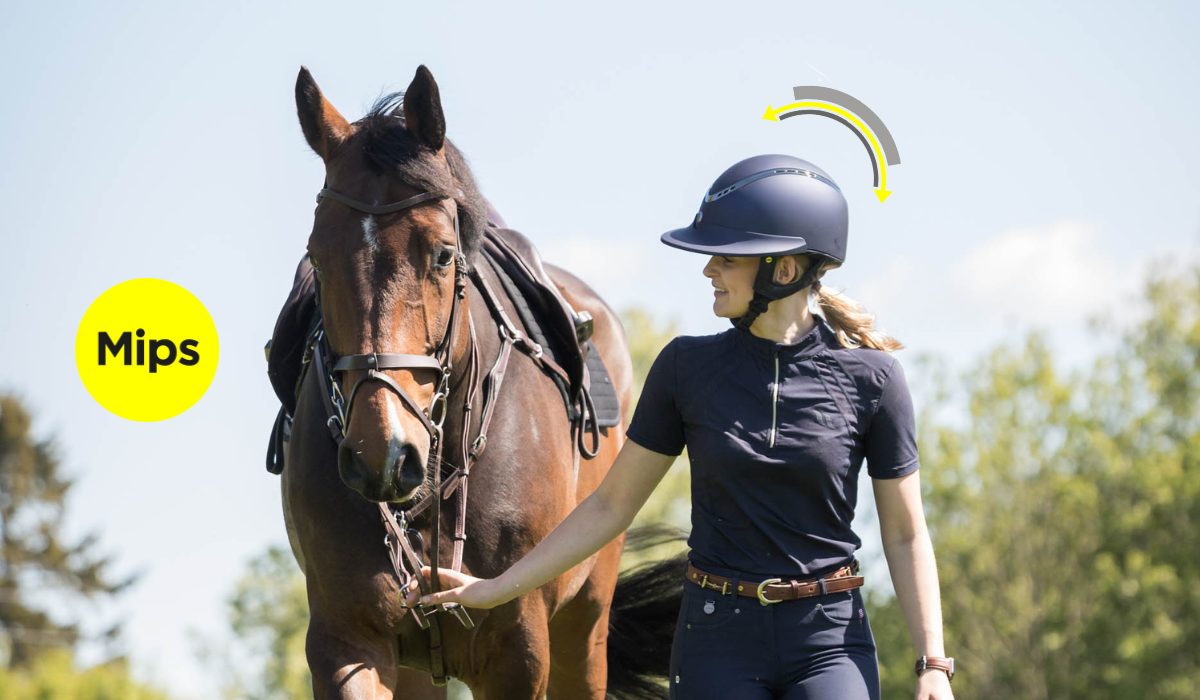
Falling off your horse and also suffering a head injury as a result is absolutely no fun. That is why wearing a good and safe riding helmet is very important! Fortunately, these days there are more and more helmets that incorporate the MIPS system. MIPS stands for: Multi-directional Impact Protection System. During a fall, our brain moves a little inside our head and is protected by a layer of fluid connected to our brain at the skull. In the event of a fall from your horse, chances of brain injury are high. The MIPS system differs from other helmets in that an extra, thin shell is fitted inside the helmet. Like the brain, this moves slightly with it during a fall. As a result, the blow to the brain is much smaller. It also reduces the risk of brain damage.
Facts about MIPS
MIPS is a Swedish invention that improves the safety of all types of riding helmets. The system is mounted on the top of the helmet and consists of two layers that can move independently of each other. This allows the inside of the helmet to move slightly in the direction of the rotational force if the head receives an oblique blow.
A standard riding helmet protects the head by absorbing the energy of a hard blow with multiple layers of material. Riding helmets are often tested by simulating impacts head-on against the helmet. This works excellently if the helmet is of good quality; the shock is dispersed through the layers of material and distributed across the helmet. The head will not break, even if the riding helmet itself does.
A riding helmet with MIPS works in the same way, but also adds a system to absorb the forces that occur when the head is subjected to an angled impact. An impact from an angle contains kinetic energy that also has a direction. A hard, angled impact causes the head to be violently shaken after the impact, exposing the brain to rotational force.
The sudden movement of the head can cause twisting of the brain. Impacts with rotation are the most damaging. Such forces can have serious consequences and lead to major damage by exposing the brain to internal tearing. The brain is particularly sensitive to this kind of deformation and the shock-absorbing fluid around the brain is not sufficient to compensate for a blow which contains a lot of kinetic energy.
This is where MIPS becomes effective, by improving the protection of the cerebrospinal fluid. Like the fluid-filled space inside the skull, MIPS absorbs some of the forces of rapid rotation. When the head can move in the direction of movement, inside the helmet, the forces acting on the brain become slightly less abrupt. Therefore, MIPS take into account both the physiological characteristics of the brain and the way physical forces act on it. Thanks to these features, MIPS can help mitigate the consequences of an accident. At Back on Track, they have always focused on safety. Indeed, they were one of the first to integrate MIPS (Multi-directional Impact Protection System) into riding helmets. This means that Back on Track's helmets have been extra safe for 15 years now. Something that usually places Back on Track first or as a ‘good choice’ in independent tests. 
Story of Lena Öhlin: Just one riding helmet away from a serious injury
When Lena Öhlin carefully stood up after the blow, she had no idea how serious her injuries were. All she felt was pain, cold and a tingling sensation all over her body. She was in the middle of the forest, on 2 April 2022 - and she had just been thrown from her horse. Fortunately, she had her mobile phone with her and was able to call for help.
It was only at the hospital that doctors discovered nine broken ribs, a broken collarbone and a broken shoulder blade. She was also badly bruised from head to toe. Yet everyone agreed that she had gotten off lightly: her head was intact - and her brain was unharmed. Lena is convinced that the helmet meant everything. The difference between life and death. Or the difference between an (admittedly painful) time of recovery and a life changed forever.
Two weeks after the accident, Lena is still in a lot of pain and her days are filled with follow-up medical appointments, further X-rays and physiotherapy. She has a long period of rest and healing ahead of her. But, as mentioned earlier; it could be worse. When it became clear how much the helmet had meant to the outcome of the accident, Lena realised she wanted to share her new, painfully acquired knowledge and hopefully make a difference in other people's lives. Her joyful enthusiasm shines through the story of her injuries.
Lena remembers the blow to her head very well. The riding helmet - a Lynx model - withstood the impact and stayed well in place until the doctors removed it. Everything broke or was cut open by medical staff. Now she likes to tell everyone around her how important it is to put safety first, wear a really reliable riding helmet and high-quality equipment.
Best in test - with good security from Mips
‘I chose the riding helmet because Folksam (a Swedish insurance company) recommended the helmet. It is the best in the test’.
However, Lena did not know at the time that she had also chosen a riding helmet with an integrated MIPS system. When it comes to the brain, very small differences can have big, significant consequences. The riding helmet has now been discarded - It is always important to always replace the helmet that has been exposed to impact - and sent it back to Back on Track so they can see what the helmet looks like after it has done its job.


