As the days grow longer and the temperatures rise, many horses begin to experience the well-known “spring restlessness.” This is especially noticeable in mares, whose reproductive cycles start up again during this period. This phase is known as estrus.
Although estrus is a natural process, some mares can be noticeably affected. Changes in behavior, reduced performance, or even resistance under the saddle are common in the spring.
So how can you recognize it, and what can you do to help?
What is Estrus?
Estrus is a natural phase in a mare’s reproductive cycle, during which she is fertile and her body prepares for mating. During this period, hormonal changes occur—mainly driven by the hormone estrogen—and ovulation takes place, which is the moment when the mare is actually fertile.
A mare’s cycle consists of two phases:
-
Estrus (heat): the fertile phase, during which a mare often shows changes in behavior.
-
Diestrus: the phase after ovulation, during which she is usually less receptive to stallions.
On average, this cycle repeats approximately every three weeks, with estrus lasting about 5 to 7 days. After this period, the mare usually becomes calmer until the cycle begins again.
Horses are so-called long-day animals, meaning their hormone balance is strongly influenced by the amount of daylight. Many mares enter a rest phase in winter, also called the transitional period. When the days get longer in spring, daylight stimulates hormone production via the pituitary gland, activating the cycle once again.
Estrus is therefore not a sudden change in behavior, but the visible result of a natural and complex hormonal process in the mare’s body.
How to Recognize a Mare in Estrus
Every mare reacts differently. While some mares barely show any signs, others may display noticeable changes in behavior and performance.
Common signs include:
-
Mood swings
-
Aggression or irritability
-
Frequent urination (small amounts)
-
Lifting or swishing the tail
-
Reduced focus while riding
-
Sensitivity when girthing or saddling
-
Ears pinned back or grumpy behavior
-
Reluctance under saddle
-
Bucking or kicking
The position of the ovaries—just behind the saddle area—plays an important role. When a mare experiences discomfort, it often shows as sensitivity along her back. This can make her less willing to carry weight, swish her tail, or even resist under the saddle.
What is sometimes perceived as “naughty behavior” can therefore simply be the result of hormonal discomfort.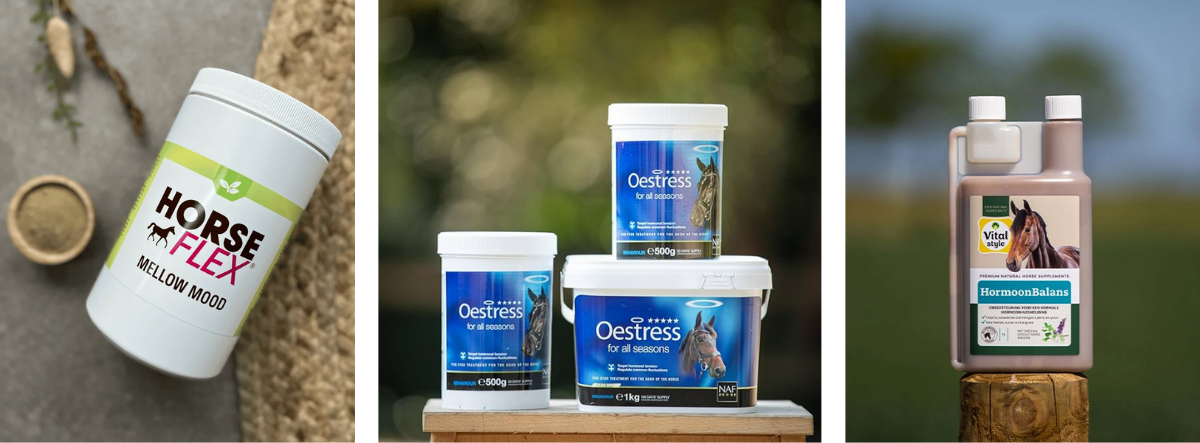
What Can You Do for Hormonal Discomfort?
Not every mare needs additional support. However, if you notice that her behavior or performance is clearly affected by her cycle, you might consider the following:
1. Adjust Training
Whenever possible, schedule intensive training sessions or competitions outside of her most sensitive days. More relaxation and understanding can often make a big difference.
2. Check Saddle Fit and Back Comfort
Because discomfort often occurs around the saddle area, a properly fitting saddle is essential. Extra pressure can worsen the problem.
3. Support with Supplements
If your mare is clearly affected by her cycle—showing mood swings, sensitivity under the saddle, tail swishing, or even bucking and kicking—targeted support can help restore balance and comfort.
At Hypostore, you’ll find a range of supplements specifically designed to support hormonal balance and promote inner calm in horses:
NAF Oestress is specially formulated for mares that are sensitive during estrus.
When hormonal fluctuations cause irritability, reduced performance, or sensitivity around the saddle area, this supplement can provide support.
-
Naturally helps stabilize the hormone cycle
-
Targets the underlying causes of hormonal discomfort
-
Supports comfort throughout the cycle
-
Suitable for mares that react strongly during estrus
Because the ovaries are located just behind the saddle area, hormonal sensitivity can manifest as reluctance under the saddle, tail swishing, or resistance while riding. Targeted support can help your mare move and perform more comfortably.
Support for Optimal Hormonal Balance
Estrus can be a stressful period for mares. Hormones surge through the body, causing physical discomfort and changes in behavior. Vitalstyle HormoonBalans helps support a normal hormonal balance. It promotes a regular cycle in mares, making it particularly useful during estrus. It can also be used for stallions and geldings to maintain a healthy hormonal balance.
Why choose HormoonBalans?
-
Supports hormonal balance in mares, stallions, and geldings
-
Helps maintain a regular cycle in mares
-
Assists with mood fluctuations during the cycle
HorseFlex Mellow Mood is a complementary feed designed to support hormonal balance and promote inner calm. This herbal blend is especially suitable for horses that show hormonal behavior, nervousness, restlessness, or are easily excitable or skittish.
Mellow Mood contains a variety of calming herbs that work together to address a horse’s nervousness on multiple levels. It includes:
-
Chasteberry (Vitex): supports healthy hormonal balance and helps manage hormonal behavior in mares, stallions, and geldings
-
L-tryptophan: an amino acid that helps release built-up tension
-
Valerian root, passionflower, and hops: contribute to maintaining inner calm
Keep a Cycle Calendar
By tracking when your mare is in estrus, you can gain insight into her pattern. This helps you plan training sessions more effectively and better understand her behavior.
Understanding Makes a Difference
Estrus is a natural part of a mare’s life. With knowledge, small adjustments in training, and—if needed—targeted support, you can help your mare navigate this period more comfortably.
If you’re unsure whether your mare’s behavior is hormone-related, the team at Hypostore is happy to provide tailored advice.